


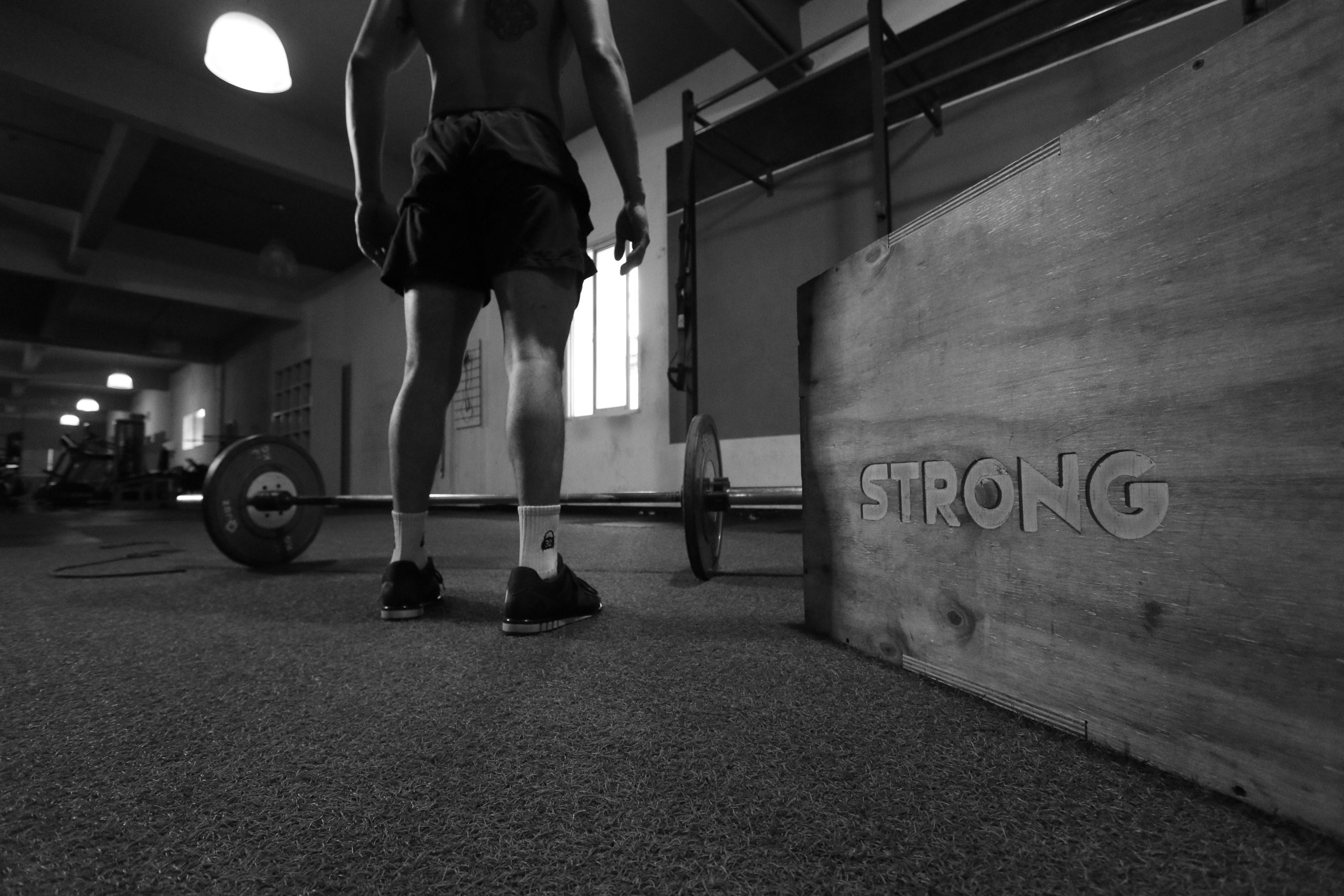
Photo credit: Estudio Polaroid
Anxiety doesn’t announce itself with fanfare. It builds quietly – in the space between your breaths, in the thoughts that circle at 3 AM, in the tension you carry without noticing. Like a weight added to your bar in small increments, you might not feel it until you’re already carrying more than you should.
We’ve mastered the art of carrying this weight in silence. Wake up, put on the mask, handle business. Repeat.
Because that’s what men do, right?
We grind through, push forward, stay strong. The problem isn’t the strength – it’s the form. And in both lifting and life, bad form eventually breaks you.
But here’s the truth about silent burdens: They get heavier the longer you carry them alone. The pressure builds in your shoulders, tightens your jaw, disrupts your sleep. You find yourself short with your kids, distant with your partner, distracted at work. These aren’t character flaws – they’re signs of poor load management.
When it comes to anxiety, think about the fundamentals of strength training.
When the weight gets heavy, you don’t just grip tighter – you adjust your stance. You control your breathing. You use proper form. You understand that raw power isn’t enough – technique matters. More importantly, you know when to ask for a spot.
The same principles apply to managing anxiety:
1. Proper Form
- Recognize tension patterns in your body.
Your shoulders aren’t meant to live by your ears. - Build consistent sleep and wake times.
Your body needs rhythm like your training needs structure. - Create space between thoughts and actions.
Not every set needs to be done at max speed. - Watch your mental posture.
Are you bracing against life or moving with
2. Breathing Mechanics
- Start your day with five deep breaths.
Make it as non-negotiable as your warm-up. - Practice box breathing during stress peaks: 4 counts in, 4 hold, 4 out, 4 hold.

- End each day with deliberate wind-down breathing.
Your mind needs cool-down sets too.I hear you saying: “Breathing is stupid. This shit is that yoga nonsense.” Cool, just do it!

3. Load Management
- Set clear boundaries around work hours.
Even the strongest lifter needs rest between sets. - Build recovery time into your schedule.
Mental gains, like muscle gains, happen during rest. - Learn to say “no” without explanation.
Not every weight needs to be your weight. - Track your mental load like you track your training load. Notice patterns, adjust accordingly.
4. Training Partners
- Find one person you can talk to openly.
The strongest lifters have spotters they trust. - Consider professional coaching when needed.
Form checks aren’t just for deadlifts. - You’ve joined a community where strength includes vulnerability. Iron sharpens iron.
✅ – DONE (thank you)
The weight of anxiety isn’t a weakness – it’s a signal.
Like the burn in your muscles during a workout, it tells you something needs attention. Ignoring these signals doesn’t make you stronger – it just leads to injury.
You wouldn’t ignore sharp pain during a deadlift.
You wouldn’t push through bad form just to move more weight.
Don’t ignore the signals your mind sends.
Don’t sacrifice mental form for the appearance of strength.
Start treating your mental health like you treat your physical training: with respect, proper form, and the understanding that strength builds over time. Some days you’ll PR1. Others you’ll need to deload. Both are part of the process.
Because true strength isn’t about carrying more in silence.
It’s not about grinding through with poor form until something breaks.
It’s about carrying what you must, with better form, one day at a time. It’s about knowing that asking for a spot doesn’t make you weak – it makes you smart.